3.16 drivetrain

Derailleur Hanger Alignment

Derailleur Hanger Alignment. Step-by-step procedure for bike maintenance — tools, time, and what to watch out for.
Difficulty ★★ moderate
Time ~15 min
Applies to All bikes with rear derailleur
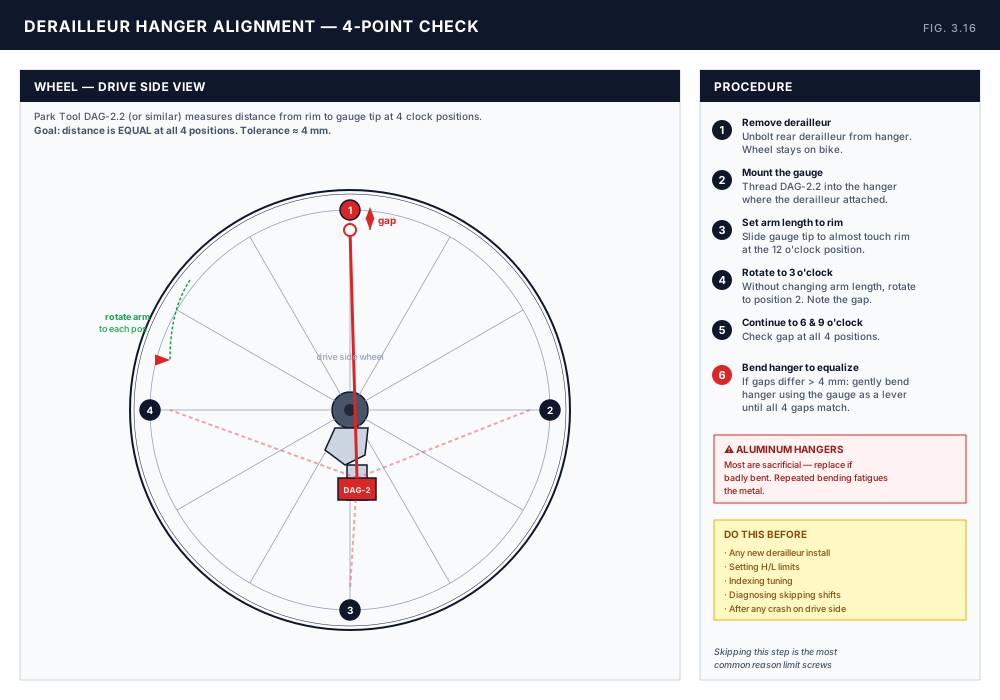
Hanger alignment 4-point check using Park DAG-2.2 gauge

Tools

  • Hanger alignment gauge (Park DAG-2.2)
  • 5mm hex

Procedure

  1. Remove the rear derailleur

    by unscrewing the mounting bolt at the hanger.
  2. Thread the alignment gauge

    into the hanger threads in place of the derailleur.
  3. Extend the gauge's measuring arm

    until the indicator (dial or pointer) sits next to the rim — typically at the 6 o'clock position.
  4. Note the measurement

    at 6 o'clock.
  5. Rotate the wheel

    (or rotate the gauge) 90° to 3 o'clock and check the gap to the rim.
  6. Repeat at 12 o'clock and 9 o'clock.

  7. All four readings should match within 1–2 mm.

    If not: - Identify the position with the largest deviation. - Apply gentle pressure with the gauge to bend the hanger toward the wheel (or away) until it matches the others. - Re-measure all four points. - Repeat until all four readings are within 1 mm of each other.
  8. Reinstall the derailleur.

    Check that shifting is now improved. > Carbon-direct-mount hangers don't bend back — they replace. UDH (Universal Derailleur Hanger) is designed to fail rather than bend the frame; some marketing says "no alignment needed," but in practice they do still bend slightly and benefit from gauge work. ---

Procedure #

  1. Remove the rear derailleur by unscrewing the mounting bolt at the hanger.
  2. Thread the alignment gauge into the hanger threads in place of the derailleur.
  3. Extend the gauge’s measuring arm until the indicator (dial or pointer) sits next to the rim — typically at the 6 o’clock position.
  4. Note the measurement at 6 o’clock.
  5. Rotate the wheel (or rotate the gauge) 90° to 3 o’clock and check the gap to the rim.
  6. Repeat at 12 o’clock and 9 o’clock.
  7. All four readings should match within 1–2 mm. If not:
    • Identify the position with the largest deviation.
    • Apply gentle pressure with the gauge to bend the hanger toward the wheel (or away) until it matches the others.
    • Re-measure all four points.
    • Repeat until all four readings are within 1 mm of each other.
  8. Reinstall the derailleur. Check that shifting is now improved.

Carbon-direct-mount hangers don’t bend back — they replace. UDH (Universal Derailleur Hanger) is designed to fail rather than bend the frame; some marketing says “no alignment needed,” but in practice they do still bend slightly and benefit from gauge work.